Monday, July 11, 2011

Road Trip: Southeast Cuba

Finally - Back to some self discipline and writing.....
 
Road Trip: Southeast Cuba – March 26 to31, 2011

The best way to see Cuba away from the “all inclusive” beach resorts is by land. Marinas are safe, secure and inexpensive. We pickled the water maker with biocide, closed up Polar Pacer and left her in the care and custody of the staff at Marina Vita. Armed with a Lonely Planet travel guide and a book of maps that came with the rented Chinese built Geely that we shared with Amazing Grace we headed down the autopista. This road trip would take us through the provinces of Holguin, Granma, Santiago de Cuba and Guantanamo with stops in the cities of Bayamo, Santiago de Cuba, Guantanamo (not the US naval base) and Baracoa.
The autopista was busy with a wide range of means of transportation. 

  Cyclists carry on a conversation with passengers on a horse drawn wagon.

 The blue license plate on this truck identifies it as a government controlled vehicle that is required to pick up passengers. The often seen message emblazoned across the front roughly translates to “Yes we can”, a familiar slogan from a recent non Cuban election. Which one came first?

Buses come in all shapes and sizes. 

Tomatoes bound for market in this dump truck made up some of the commercial transportation 
 
The red license plate on our car identified it as a rental for tourists.
 
Sidecars make good cargo carriers. 

 Hitchin’ a ride.

Our first stop was Bayamo where we were introduced to the “casa particular” system.  A casa particular is a private home that has been licensed to rent rooms to foreign tourists. They are identified by a symbol that looks like an upside down anchor. The same sign in red indicates rooms for rent to Cuban tourists. 

We were shown to Casa Arturo y Esmerelda by a young man who had been summoned by the receptionist at a hotel where we had unsuccessfully gone looking for rooms. Arturo had only one room available but had a friend just around the corner with another room. Room rates are standardized at 25 CUC (convertible pesos) per night, roughly the equivalent of $25 Canadian.  Breakfast and dinner are available at reasonable prices. Breakfast typically consists of a selection of fresh fruit and juice, cheese, ham, egg, fresh bread and coffee. When we chose to eat in for dinner we had choices and usually opted for chicken or seafood. Our casa hosts were also good cooks. 

 This taxi is one of many privately owned Classic American cars that continue to run and have recently been licensed to operate alongside their government owned counterparts. 

Tomato puree is distributed for home use from a window opening onto the street. Bring your own container.

Typical Bayamo homes.
 
 Live music is everywhere - an evening practice session.
 
 Across the street from our casa was the panaderia.  In this case the bread was not baked on location but transported her from the factory for distribution. The prices are posted in national pesos. One convertible peso is the equivalent of 25 convertible pesos. A large loaf of bread costs about 35 cents Canadian.
 
Santiago de Cuba, the second largest city in the country, was the next stop on our route. Our hosts in Bayamo referred us to families in Santiago who had rooms to rent near the historical central core of the city. Our challenge was to find them. The original city planners created narrow cobblestone streets that today can only accommodate one-way traffic. Most street signs are either missing or illegible. 

 Navigating around the dead ends, unmarked construction and households spilling out onto the roadway was a challenge.   

Let’s just say that after several unsuccessful attempts at finding a bed for the night we paid a local jinitero(hustler) to get in the car with us a guide us to one of the addresses that we had been given.
Santiago presented our first opportunity to sample Cuban street food. Tom stood in a long line at a cadeca and exchanged some convertible pesos for the national pesos that most street vendors do business in. One convertible peso, roughly the equivalent of one Canadian dollar, converts to 25 national pesos. 

 One of our favorites was the roast pork sandwiches. At this stand they are offered at 5 national pesos or about 20 cents. Tasty but don’t expect any condiments.

Soft icecream, half chocolate and half pineapple and just the right size for one peso (four cents).

Everywhere we travelled we saw architectural restoration in progress. 

 Public buildings and private residences alike sported fresh coats of paints and construction permits were posted on projects still to come. 
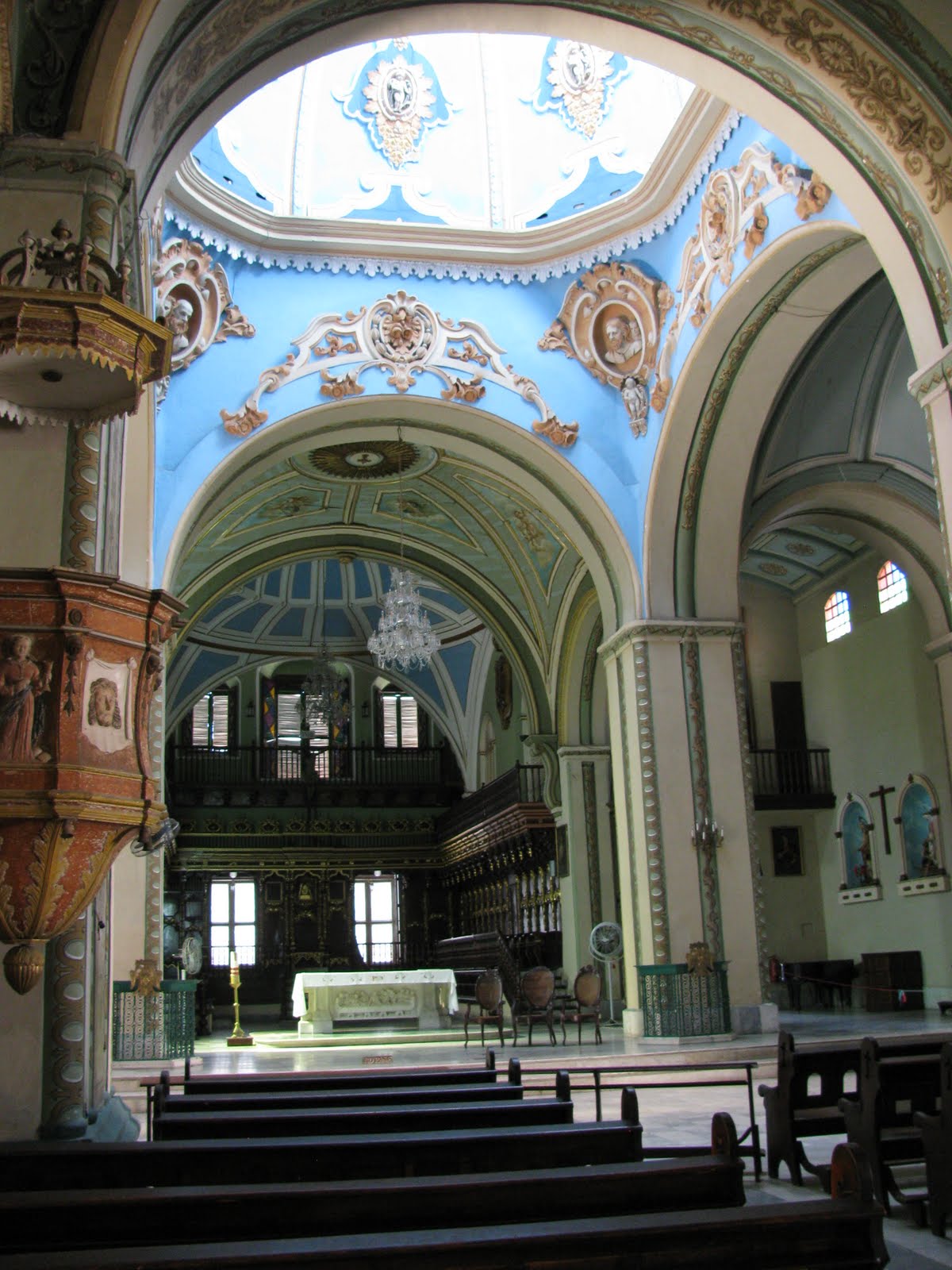

Much of the Catedral de Nuestra Senora de la Asuncion has been restored but it remains a work in progress.

We happened upon the music hall (casa de la trova) in Santiago quite by accident. After a tasty lamb dinner in a paladar near the cathedral and some Cuban coffee that, unlike Folgers and Maxwell House, does not keep me awake at night, we were making our way back to our casa and admiring the architecture. Lively music was coming from the building across the street from the Bacardi Museum. We had to check it out.  

 For a cover charge of about a dollar we had front row seats for an up close and personal performance of traditional Cuban music and salsa dancing. Authentic, mint infused mojitos were served to us in our seats.

 Members of the Cuban Navy stopped by to contribute to the entertainment.

Oxen are not an uncommon form of transportation. We met this pair on our way to Guantanamo.

 We passed through Guantanamo at lunch time. Personal size pizza dripping with melted cheese for 5 national pesos (20 cents).

 Iced fruit juice served in cut off beer bottles.

Baracoa, on the southeastern tip of the island, was our final stop. Famous for chocolate production, Baracoa is mostly underdeveloped as a tourist destination. 

The winding highway through the mountains provides awesome vistas of the Cuchillas de Baracoa Mountains. 


We found rooms in one of the casas listed in Lonely Planet.  The decorating challenge industry could find material for many seasons here.
 
Playa Maguana is a short drive from town. When we arrived at the beach we were approached by a local fisherman who offered to cook lunch for us. Grilled lobster was the only thing on the menu.

 As we waited for our meal we watched a fresh catch being brought in. Those are adult size flippers! 

 Nothing is wasted. This visitor came by to clean up after us. Nothing like a few spent lobster shells for an afternoon snack.

We can attest to Lonely Planet’s claim that excellent meals are to be had in the casas of Baracoa. Our hostess created some amazing meals for us using local fish, shrimp and lobster (too bad about the cholesterol).  Alien, an English teacher by day, and Anthony, one of his former students, now working together in the Restaurante Latino by night, made marvelous mojitos for us when we stopped by for after dinner night caps. We still keep in touch by email.

The northern, less travelled route from Baracoa back to Varadero does not pass through any tourist developments and therefore has probably not been resurfaced since it was first built. 

It passes through Moa, home to a large pollution belching nickel smelter. The naturally red soil of the surrounding country side makes it looks like the aftermath of some kind of nuclear disaster. 

 Apparently there were signs advising against taking photographs. I missed them.


Thursday, June 9, 2011

Cuba. Si!

Cuba. Si! – March 23 to 25, 2011

The alarm was set for 3:00 AM with the intention of pulling up the anchor and being on our way by 3:30. We had made our departure preparations (securing the dinghy, plotting our intended route, packing the ditch bag, etc.) the evening before. At 4:00 AM we left Spanish Wells Bay on Raccoon Cay with two other catamarans also headed for Cuba. With a ¾ moon overhead and the cool night breeze on our faces it really felt like we were off on another new adventure. 

Since our chart reader was still not functioning, the plotter would only display a stylized map of the world showing approximate locations of land masses and no depth soundings. We were about to venture into unfamiliar waters without the use of one of our electronic crutches. How did Christopher Columbus ever make it to America?

The banks west of the Ragged Islands are mostly un-surveyed and scattered with shallow coral. Our Explorer Chart Book has a single charted path with waypoints that we found to be reliable for our southward movement down the cays. From our anchorage at Raccoon Cay we headed for a point at approximately 22o 05’ N; 75o 55’ W, where we exited the banks and entered the deep water of the Old Bahama Channel.

 By 6:30 Am the eastern sky had lightened up and in the distance we could see the sails of the other two boats. By 8:00 AM the fishing competition had begun and we had three lines out. An hour later our travelling companions had already landed several mahi and a couple of barracuda. We had only managed to snag some weeds.
 
Eventually we did get a mahi too.

Most of the crossing was done in choppy, washing machine waves using full main and jib assisted by the engine in order to keep our speed around six knots. We wanted to time our arrival at Puerto de Vita, the only port of entry on that section of the coastline, in good daylight.  

 At noon we were able to make out land on the horizon. By mid afternoon we were approaching the coast of Cuba and could see the lighthouse marking the entrance to Bahia de Vita. 

We assumed that the Spanish voices we heard on the radio were Cuban officials trying to make contact with us. I used my rehearsed lines from our Spanish for Cruisers guide:
Aqui  velero Polar Pacer.”
“Bandera Canada”
I was not able to decipher the responses that came back at me but I now know that they were probably asking where we were arriving from and how many persons were on board. I was only able to answer with:  “Lo siento, no comprendo.” Eventually a heavily accented voice came on the radio telling us in English to “follow the little boat”.
Alexi, on the little boat, guided us through the marked channel and around the shoals into the well protected Bahia de Vita where we were instructed to anchor and wait until the officials could check us in to the country. 

The first person we needed to meet with was Dr. Ronaldo who was busy at the hospital. As it was already late afternoon, all six boats in the anchored in the bay had to wait until the next morning.  Shortly past 8 o’clock sharp Alexi arrived with the doctor on board his little boat. In order of arrival, each boat was visited to ensure that no communicable diseases were being introduced to the country. Anyone arriving from the Dominican Republic was given precautionary ant-cholera pills. Speaking very good English, Dr. Rolando asked us a few basic medical questions, checked that our refrigeration system was in good working order and had us fill out three forms. Soon we had our “Libre Platica”, the official document giving us permission to go to shore to finish clearing in.  After ferrying the doctor to the next boat in line, Alexi  came back to guide us into the marina and dock – med moor style – stern to the dock, bow anchor out in the channel and tied to a mooring ball on either side of the bows.
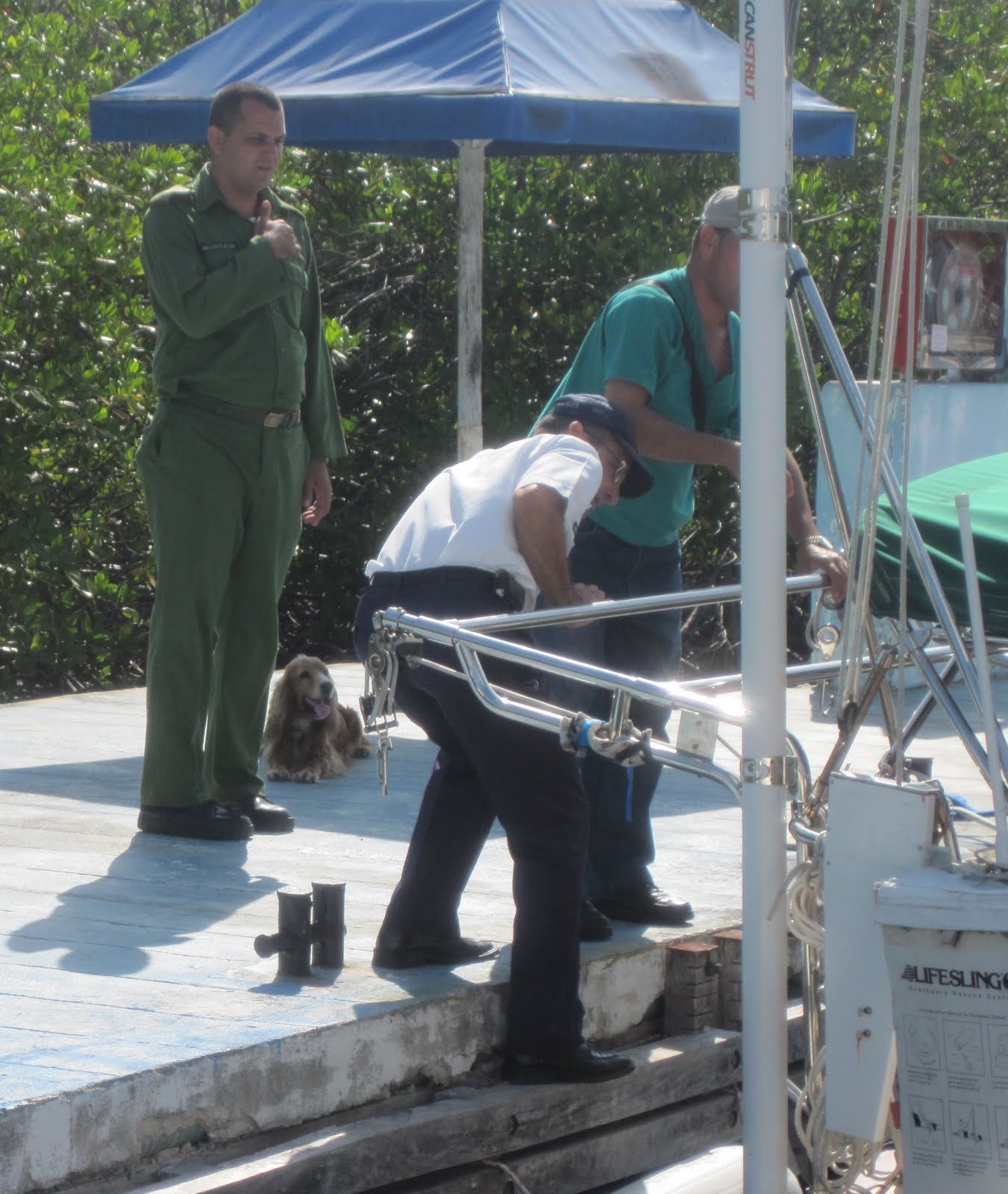
Five more officials came on board. The veterinarian checked for unacceptable meat and vegetable products. We had none. A customs officer collected information related to our boat, dinghy and GPS units. 

  A representative from the ministry of the Interior handled the immigration documents. He returned later with our passports and tourist visas. Although the visas indicated that they were only valid for 30 days we were advised that as Canadians, we would not need to renew them until 90 days.

 A pretty spaniel and dog handler checked the boat for illegal substances. We had none. 
 
The Guarda Frontera was there for general security reasons. 

Puerto de Vita sees about 30 cruising boats each year. From March 23 to 25, eleven boats checked in.  It was a busy time for the officials and appears to be a sign of things to come as interest in Cuba increases among the cruising community. Everyone was extremely pleasant and accommodating and welcomed us to their country. By 1:30 in the afternoon the check in process was completed and Tina, the dock master, arranged for taxis to take us to the nearby resort town of Guardalavaca where we could go to the bank and change our money for Cuban convertible pesos to pay for our entry stamp ($20CUC) and veterinary inspection ($5CUC). Sometimes there is also a fee for the doctor’s visit but we were not charged.  Canadian cash is the best currency to take to Cuba. The exchange rate is slightly better than the US dollar and the 20% surcharge does not apply. Second best is a Canadian credit card. The transaction is processed in US dollars but without the surcharge. US credit cards are not accepted. 

 The batting cage across the street from the bank in Guardalavaca is evidence of Cuba’s passion for baseball.

Our first sighting of a Classic American automobile.

 Tourist trinkets.

 Tourist beach.

  Tourist beer

All inclusive resorts are not why we came to Cuba. Time for a road trip.


Thursday, May 12, 2011

Leaving Long Island and the Bahamas

Leaving Long Island and the Bahamas – March 13 to 22, 2011


When we first arrived in the settlement of Salt Pond on Thompson Bay our friends made arrangements to leave Long Island via Southern Air with a connecting flight to Nassau where they would catch a direct flight home at the end of their holiday. Sandra had done her homework back in Canada and knew that they could get a flight from Stella Maris Airport. She also knew that boats staying at the Stella Maris Marina have full access to the activities and amenities at the Stella Maris Resort and wanted to treat us to a couple of days in the marina. What she did not know is that the marina and the resort are on opposite sides of the island! Good for us that the amenities include shuttle service between the marina and the resort.


Southern Air flies from Stella Maris Airport


As we made our way north to the marina the fishing lines were in the water. Two hours after pulling up anchor at Thompson Bay, Tri landed this feisty fellow. As we do not eat barracuda, back in the water he went.


Not taking any chances, the freezer had been replenished with grouper and hog fish from a local fishing boat in Thompson Bay before we left. The second annual “Cooking with Tri” episode would go on as scheduled. We arrived at the marina after a beautiful sail in 14 knot winds and using eyeball navigation to find our way. The narrow dredged channel could be identified by the very slightly darker colour of the deeper water and the barely visible, thin poles topped with the remains of Styrofoam fishing floats. Oh yes, and don’t forget to keep those poles to port as you are going in.


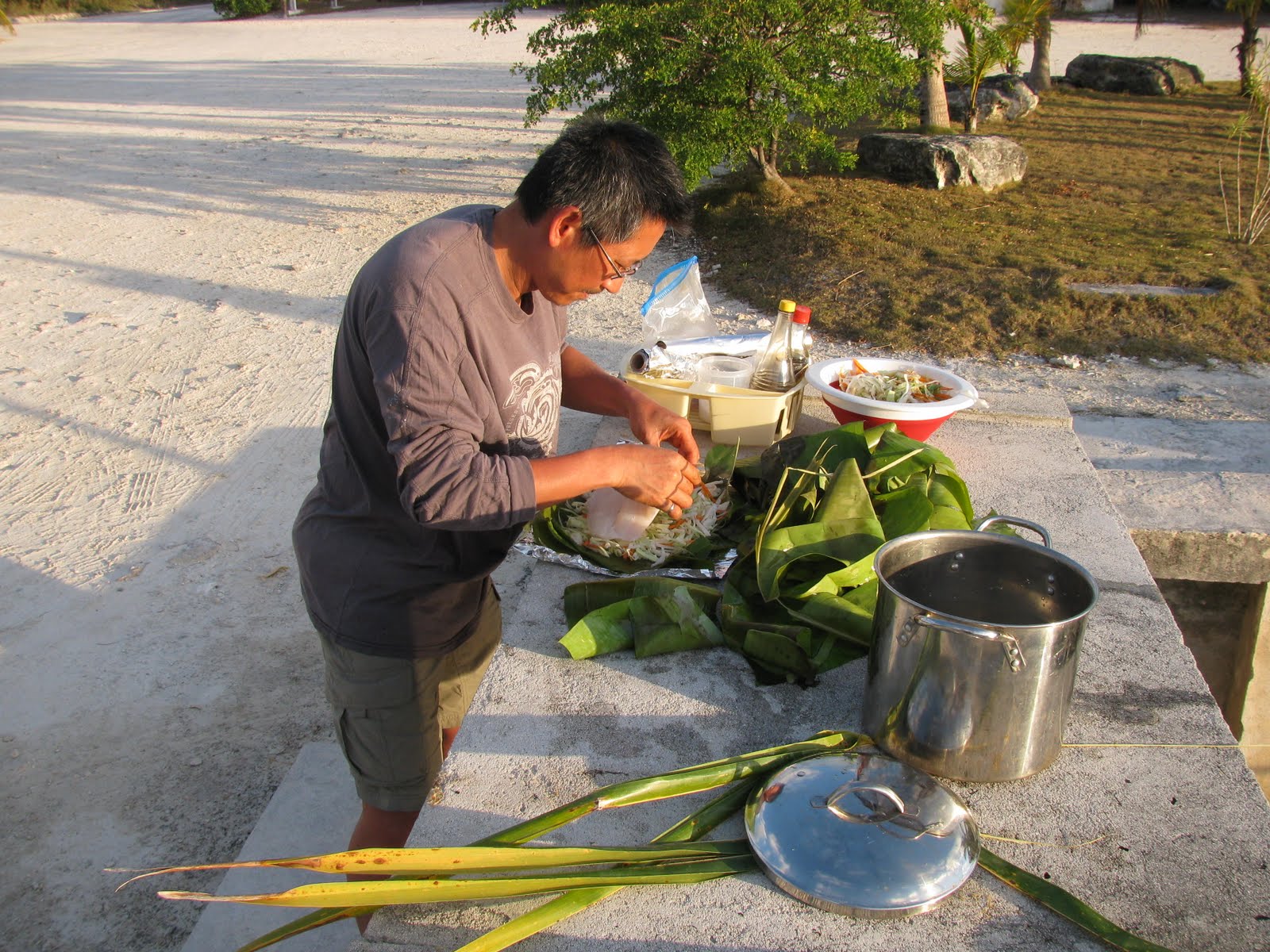
Chivago, the nice young dock master at the marina, returned from lunch with the banana leaf that Tri needed to wrap dinner in. I guess we should have mentioned that how much we needed.


Hog fish encased in banana leaves with shredded cabbage, carrots, onions and a few other secret ingredients, then a wrapped in foil and baked on the BBQ.


Harvesting coconut water for sky juice – a Bahamian thirst quencher. Polar Pacer’s version: Mix a generous shot of gin with a glass of coconut water. Add a tablespoon or two of sweetened condensed milk and lots of ice. Stir and enjoy.


Charades? Waiting for the morning shuttle to take us to the resort.


It is not often that we play tourist and spend the day at a resort. In fact this was the one and only time since we started this adventure. What a treat. We signed up for the half day trip to Cape Santa Maria to go snorkeling and didn’t even have to take our own towels to use at the beach. There were fresh water showers and a swimming pool at our disposal. No tracking salt and sand back to the boat! The poolside restaurant where we had lunch has an awesome view of the Atlantic.


Sandra checks out the tidal pool.


Next stop – Africa.


Evening entertainment at the resort consisted of a free rum punch party with appetizers and Rake ‘n Scrape. . That’s my Bahamian Uncle Bud on the far left.


Chicken and ribs on the outdoor grill. We were also treated to a very delicious buffet meal in the dining room before summoning the shuttle to take us back to our beds on the other side of the island.


The sadness of having our friends leave for home was soon filled with the anticipation of our next big milestone – heading for Cuba. We made use of the laundry facilities across the road from the marina where the proprietor turned out to be a fellow postage stamp collector. Cynthia very generously offered me the duplicates from her collection and I promised to reciprocate when I returned to Canada. The next morning we said goodbye to Chivago and headed back to Thompson Bay where we expected to connect with other Cuba bound boats and would stock up on a few provisions. We had heard that food would be easy to access in Cuba but were not sure how long it would take us to get there.


We found two locations in Salt Pond where we could access wi-fi. We could not pick up either signal from the anchorage so we had to dinghy in to shore with our computers to check email, do banking, check the weather websites and all the other things that need to be done when you are suffering from web withdrawal. Island Breeze has a dinghy dock and is conveniently located across the road from a well stocked grocery store. Tryphena’s Club Thompson Bay is at the opposite end of the bay where you must take your dinghy in to the beach, tie it securely to tree to ensure that the tide does not take it away, and walk half a mile up a dusty hill. In both locations the service was free of charge.


We always felt welcome at Club Thompson Bay. Tryphena was always glad to see us and hoped that while we spread our laptops out on one of her tables and plugged in we might buy a cold Kalik or some of her delicious cracked conch. Let’s just say that the atmosphere at Island Breeze was not always as congenial.


The Royal Bahamian Police Band arrived in town the day before our planned departure. There were two performances to send us off in style.


The Marching Band paraded back and forth in front of the crowd on a short dead end road near the waters’ edge. The drummer on the right is wearing a real leopard skin.


The lead crooner from the Pop’s Band ‘wow’d the ladies with his vocal and dancing talents. Michael Buble beware!


The Long Island Breeze dinghy dock. A short walk to the park.


For my birthday this year I took a cruise. A self guided cruise in the southwestern Bahamas from Salt Pond, Long Island to a remote anchorage on the western side of Flamingo Cay in the chain of small uninhabited islands that make up the Jumento Cays. We made the trip with two other catamarans. This would be our staging ground for the crossing to Cuba.


Birthday girls. Julie and I share a birthday. After a long day on the water we were rewarded with a wonderful lamb chop dinner (Many thanks to Chi Chi Maru) and not one, but two birthday cakes. And a special thank you to Phil who sent me a birthday hug via single side band radio and to John who did the relay for him.


We sat out a day of rain squalls in the lee of Flamingo Cay before making our way south to Raccoon Cay where our NV charts were scrutinized for hazards, the back-up navigation system of laptop and Garmin GPS combination was made ready and the required waypoints were double checked. In order to make landfall in Cuba during daylight hours we needed to leave Raccoon Cay in the wee hours of the morning.


The Jumentos Cays are frequented by Bahamian fishing boats looking to fill their holds before heading back to their home ports. We were able to stock up on hogfish and fresh lobster.